
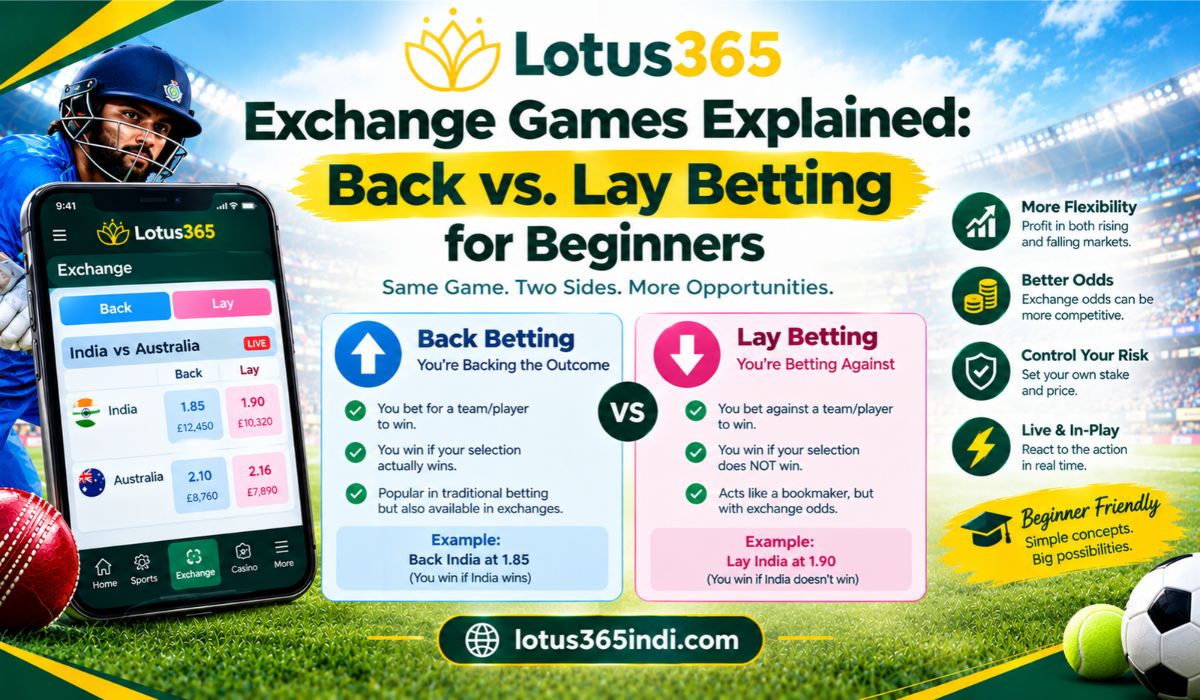
When you first open a betting exchange like Lotus365, the interface can look intimidating. Instead of simple “Win/Lose” buttons, you see two distinct columns labeled “Back” and “Lay.” For beginners accustomed to traditional sportsbooks, this dual-option system is confusing. But understanding it is the key to unlocking better odds and more strategic control over your wagers.
Unlike traditional bookmakers who set fixed odds against you, an exchange acts as a marketplace. You are betting against other users, not the house. The platform simply facilitates the match and takes a small commission on net winnings. This peer-to-peer model introduces the concept of laying, which fundamentally changes how you can approach sports betting.
What is Back Betting?
Back betting is exactly what you are used to in traditional sportsbooks. When you back a selection, you are betting that a specific outcome will happen.
- Example: You back India to win a T20 match at odds of 2.00 with a ₹100 stake.
- If India wins: You receive ₹200 (₹100 profit + ₹100 stake).
- If India loses: You lose your ₹100 stake.
In an exchange, backing works identically to a traditional bookmaker. The only difference is that the odds are determined by market demand rather than a bookmaker’s margin. Because there is no built-in overround protecting the operator, exchange back odds are frequently higher than those offered by traditional sportsbooks for the same event.
What is Lay Betting?
Lay betting is the inverse of backing. When you lay a selection, you are acting as the bookmaker. You are betting that a specific outcome will NOT happen.
- Example: You lay India to win at odds of 2.00. Another user backs India for ₹100.
- If India loses or the match is tied: You win the backer’s ₹100 stake.
- If India wins: You must pay out the backer’s potential profit. Your liability is calculated as (Odds – 1) × Stake. In this case, your liability is (2.00 – 1) × ₹100 = ₹100.
This ability to bet against an outcome is what makes exchanges unique. It allows you to profit from situations where traditional sportsbooks offer no value. If you believe a favorite is overpriced, you can lay them instead of being forced to either back them or avoid the market entirely.
Understanding Liability: The Critical Difference
The most important concept for beginners to grasp is liability. When you back a bet, your maximum loss is always your stake. When you lay a bet, your maximum loss is your liability, which can be significantly higher than your potential profit.
| Action | Max Profit | Max Loss | Risk Profile |
| Back | Stake × (Odds – 1) | Stake | Defined & Limited |
| Lay | Backer’s Stake | Stake × (Odds – 1) | Potentially Unlimited |
Always check your liability before confirming a lay bet. Exchanges typically display this figure prominently in the bet slip. Never lay a selection without verifying that you have sufficient funds in your account to cover the potential payout. Insufficient funds will cause the lay bet to be rejected or partially matched.
Why Use an Exchange Over a Traditional Sportsbook?
Exchanges offer several structural advantages for informed bettors:
1. Better Odds
Traditional sportsbooks build a margin (typically 5-10%) into their odds to guarantee profit. Exchanges remove this margin. While they charge a commission (usually 2-5%) on net winnings, the raw odds are almost always superior. Over hundreds of bets, this edge compounds significantly.
2. Trading Opportunities
Because you can both back and lay, you can trade positions during a live match. If you back a team at 3.00 pre-match and their odds drop to 2.00 after they score early, you can lay the same team at 2.00 to lock in a guaranteed profit regardless of the final result. This is impossible with traditional fixed-odds betting.
3. Market Depth
Experiments show that exchanges often offer markets that traditional bookmakers refuse to price due to uncertainty. Niche leagues, player props, and exotic outcomes frequently have deeper liquidity on exchanges because the crowd collectively determines fair value.
Beginner Mistakes to Avoid
- Confusing Lay Odds with Back Odds: A lay odds of 2.00 does NOT mean you win double your stake. It means you risk double the backer’s stake. Always think in terms of liability, not potential return.
- Laying Without Liquidity: Check the available amount to match at your desired odds. If only ₹50 is available to lay at 2.00 but you want to lay ₹200, your bet will be partially matched. Unmatched portions remain active until cancelled or fully matched, exposing you to unintended risk if odds shift.
- Ignoring Commission: Factor in the exchange’s commission when calculating expected value. A 5% commission on ₹100 profit costs ₹5. High-frequency traders must account for this in their edge calculations.
- Over-Laying Favorites: Laying a heavy favorite at 1.20 offers minimal profit (20 on ₹100 stake) but carries massive liability (₹200). One upset wipes out ten successful lays. Assess risk-reward ratios carefully.
Frequently Asked Questions
Can I both back and lay the same selection?
Yes. This is called “greening up” or hedging. If you backed a team at 3.00 and later lay them at 2.00, you lock in profit across all outcomes. Many traders use this strategy to secure returns before a match concludes.
What happens if my lay bet is only partially matched?
The matched portion stands as a valid contract. The unmatched portion remains open in the order book until another user takes the opposite side, you cancel it, or the market suspends. Monitor partially matched bets closely during volatile periods.
Is laying legal in India?
Betting exchanges operate in a regulatory grey area similar to traditional online sportsbooks. Laws vary by state. Always verify compliance with local regulations before participating. This article is for educational purposes only and does not constitute legal advice.
Do exchanges offer bonuses like traditional sportsbooks?
Rarely. Exchanges compete on odds quality and liquidity, not promotional spend. Bonuses are uncommon because the business model relies on commission volume rather than margin capture. Evaluate platforms based on market depth and commission rates, not welcome offers.
A Note on Responsible Gaming
Exchanges introduce complexity that demands greater discipline. The ability to lay and trade can create an illusion of control that encourages over-staking. Liability can escalate faster than intuition suggests.
Set strict loss limits specifically for exchange activity. Treat lay bets with the same bankroll management rigor as back bets. If you find yourself chasing losses through increasingly aggressive lays or frequent trading, step away immediately. Use self-exclusion tools and seek professional support if gaming habits become unmanageable.
Your financial safety depends on respecting the mechanics of the platform, not just the excitement of the opportunity.